[00:00:00] Speaker A: Foreign.
My name is Nancy Farrow, also known as Mama Lu, and I'm the founder of Epic Experience.
Epic Experience mission is to empower adult cancer survivors and thrivers to live beyond cancer.
I hope that as you listen to campfires of hope you living beyond cancer, you find hope, healing and empowerment.
Through stories and education, we aim to guide those impacted by cancer and more importantly, offer love and support to anyone out there who needs it.
This is beyond cancer.
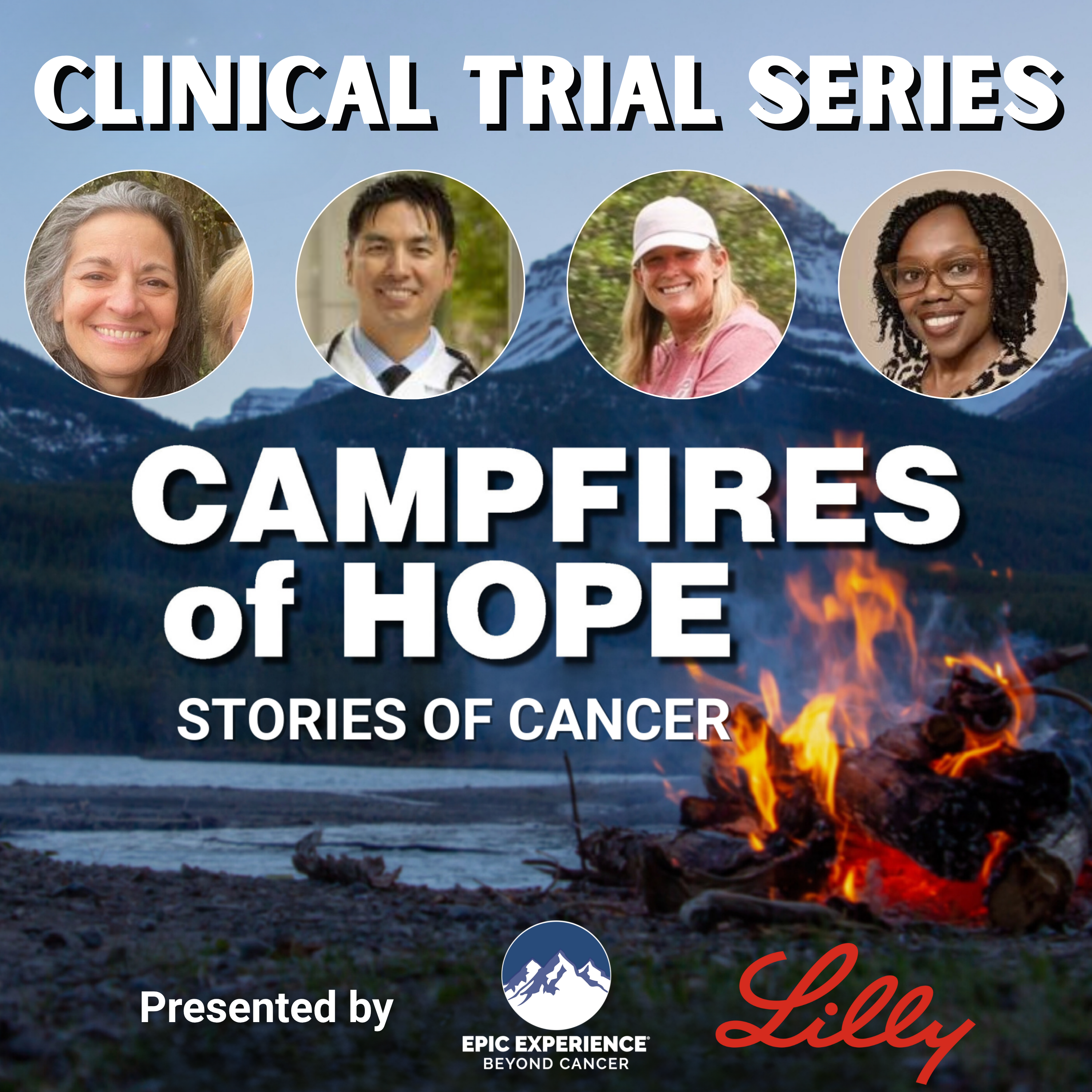
[00:01:12] Speaker B: Hello, everyone. This is Gail, AKA Sunshine. Today we have Leanne Barker and Christina Gambogi joining us around the campfire. February is Cholangiocarcinomia Awareness Month and, and we're honored to have both Leanne and Christina here as survivors to tell us their stories and perspectives.
So I am so glad that I am going to start over because that was horrible. So, Chris, we're going to stop and we're going to start over again.
[00:01:40] Speaker C: You almost had it, though. You were so close.
[00:01:43] Speaker A: I was so close.
[00:01:44] Speaker C: So close.
[00:01:46] Speaker A: I knew it was going to happen.
[00:01:47] Speaker B: I know Chris and I have done this. He knows when I. He knows when I'm going to start over.
[00:01:51] Speaker A: We're starting over.
Okay. Oh, good. It's not right. Do your best.
[00:01:58] Speaker C: We'll just pause for a second and then you can just go.
[00:02:00] Speaker A: Jump right in.
[00:02:00] Speaker C: It's already on.
[00:02:01] Speaker B: Okay. So I can just go.
[00:02:02] Speaker A: Okay.
[00:02:04] Speaker B: Hello, everyone. This is Gail, AKA Sunshine. Today we have Leanne Barker and Christina Gambogi joining us around the campfire. February is Cholangiocarcinoma Awareness Month and we're honored to have Leanne and Christina join us and share their stories and perspectives as Cholangiocarcinoma survivors. So, so welcome to you both. It's so good to have you.
[00:02:24] Speaker C: Thank you. Good to be here.
[00:02:26] Speaker B: So what we're going to do is first I'm going to ask each of you to tell us a little bit about yourself, where you're from, family, career. And I also ask everyone to share one fun fact. So I'd like you guys to do that too. So, Christina, let's have you start.
[00:02:40] Speaker C: Okay. My name is Christina Gambogi. I live in New Jersey. I have two kids. I have a 19 year old son, C.J. and my daughter, 15 is Alexis. And I said that backwards, but who cares? And you know, I work as a dairy manager still for shoprite. And one fun fact about myself is I'm a party in a box. That's what I told my fellow patients and I still live true to that so proudly.
[00:03:07] Speaker B: You're gonna have to define what you mean by party. In a box.
[00:03:10] Speaker C: Okay? So this girl ain't letting nothing get her down to, to say it better, even a cancer diagnosis. It doesn't mean I don't have bad days, but I'll be damned if cancer is going to be ruined in my life. So I rock on and rage on. So that's, that's me in a nutshell.
[00:03:29] Speaker B: All right, Leanne.
[00:03:33] Speaker A: I'm Leanne. I live in Minnesota.
I have a wife of few years now, as well as two furry children.
I have a mini schnauzer and an Australian shepherd and they are pretty much my babies.
A fun little fact. Christina and I each found out that we have our babies named Peanut and we instantly bonded over that. My Peanut is my miniature schnauzer. She just turned seven and she's a little under the weather this week, but she's a tough little cookie and is really my, my right hand during this journey. Besides my wife, she's been my, my comfort and my, my listening ear for many of many aspects of this journey.
[00:04:26] Speaker C: I love it.
[00:04:26] Speaker B: I love hearing about our support furry friends.
[00:04:30] Speaker A: And I also still work full time. I'm a social worker with our local county and I, I've been doing that for quite a few years now.
[00:04:43] Speaker B: Great.
Well, what brings us here obviously is your diagnosis. Both of you share a diagnosis of cholangiocarcinoma. And so I'm wondering if you can each share briefly your diagnosis story, when you were diagnosed, treatment and that, and whoever speaks first, if you can also share with us the definition of cholangiocarcinoma.
[00:05:05] Speaker C: I mean, sure.
[00:05:06] Speaker B: So party in a box. Go for it.
[00:05:09] Speaker C: I'm gonna, I'm gonna do my best interpretation of the definition of cholangiocarcinoma, but it is the cancer of the slender tubes of the bile ducts. So many people associate it with liver cancer, which is not entirely accurate.
It at nine times out of 10 it goes into the liver because your bile ducts are in your liver and your bile ducts are the stuff, you know, that flush out all the gunk and all that good stuff that we need.
I was diagnosed on officially on September 9th, 2021. So I am a four and a half year survivor now.
Stage four. Thank you. It's a, it's a great deal to be here.
I am a stage four survivor. I have had to attempted resections which both did not work because it's just not my time yet.
And a fun fact I should have shared is that cholangiocarcinoma was brought me and Leanne together because I am her mentor. Like I mentioned earlier in our pre discussion, she was assigned as one of my mentees.
And I think just because of our age and just our chill, kind of like, vibe, she had the yin to my yang. So we always just kind of compliment each other and we formed more of a friendship.
And, you know, she's one of my best Clangio friends in our squad. So that's. That's my story there, and that's a little brief synopsis of what kind of calangio is. And there's three stages clan. There's three different forms of Clangio. You have intravahatic, you have hilar, and you have extra hepatic.
I have intrapepatic. And I believe I'm gonna let Leanne take over so she can explain what kind she is.
[00:06:49] Speaker A: I'm also intrahepatic.
Stage four.
I was diagnosed not stage four, not so much because it had metastasized to other, but because it was so large. My mass was 16 cm, so it took up most of my liver area and all of my bile duct area.
Many people kind of wonder constantly, you know, what is the bile duct? What does it do?
You know? And that's exactly like Christina explained. It's. It's kind of like it looks like a tree on the side of your liver and going through. It's those blood vessels and it's routing and, you know, clearing all that gunk. And unfortunately, that's where ours began.
And yes, many people say that I have liver cancer, and I don't. It's cholangiocarcinoma. It's worse than liver cancer.
Why?
The hard thing is that there's no cure for.
Doesn't matter what stage you're at, but there is no cure out there.
There's things that can lessen some of your tumors.
Sometimes they work, sometimes they don't.
It's a cancer that is often found in older folks. But in recent years, we've found that it's been diagnosing younger and younger. We've seen people in their 20s get diagnosed.
There's been a few stories on the news of people even younger than 20 getting diagnosed.
And it's something that oftentimes can't be beat.
There's no perfect cure.
The goal you start with is aiming for six months. You want to beat that.
Then after that you want to beat a year, then you want to beat two years, then it's five years, then, then it's 10, then it's 15.
And just to make it to each one of those milestones is a huge accomplishment because it is such a hard, hard disease.
I was diagnosed in November of 22.
I went in for some abdominal pain that I thought was some ovary problems, and they said, you know, you're clear, but we got to discuss this. And the ER doc actually sat down and kind of put his hand on my knee and said, we've got to talk, and we're fine. You know, what is it? What. What's so bad? You know, because you could see the look on his face. And he said, you need another scan in the morning.
You need an mri. We need to figure out what's going on, but it's not good.
And I, you know, asked the probability of it being benign, and he said, not. Not for how big it is. Wow. So within a week, I had the mri, I had a biopsy. I had boom, boom, boom. Each week was a different test and a different procedure, and it came out to.
Came out adena carcinoma. When they did the testing, it came out to Cholangio, and unfortunately, there was no looking back. From there, it was, get me into chemo. Let's go, let's roll. Let's do what we need to do. Give me a port.
You know, and it was a lot of complications in my beginning stages.
I seem to have a complication with any. Everything.
I had a port put in. The port didn't work, so we had to use and put in a different port.
The ended up having the treatment the first time, and because it was done through my arm that second time, I ended up with blood clots.
[00:10:39] Speaker B: Oh, gosh.
[00:10:40] Speaker A: It was just one thing after another, and it was a complicated story. So in the meantime, I was reaching out to the Cholangio Carcinoma foundation, and I asked for a mentor and ended up with Christina, I think, by January.
So it was somebody that could help me understand all this medical lingo, could help me understand where the heck I was going with this process.
Yeah.
[00:11:11] Speaker B: Yeah. So were you both in your 20s or 30s when you were.
[00:11:15] Speaker A: I was 39.
[00:11:16] Speaker C: I was 42. Oh, okay. She was 39. I was 42. So talked over. So I want to make sure that was clarified.
[00:11:22] Speaker A: Yeah.
[00:11:23] Speaker B: But you're still.
[00:11:24] Speaker C: I mean, you were very close in age. Probably. Probably. For me, it was like finally there was someone more like my age, you know, because most of the people I was meeting were in there, you know, later. Not that anyone deserves this by any means, but you want to talk to someone that's a little more like, you know, just in your age group. So you can kind of associate with the same kind of things. We're in the same place of life, you know?
[00:11:46] Speaker B: Right, exactly.
[00:11:48] Speaker C: And just to clarify, a little more sunshine, because I know you're kind of asking like, like, you know, if when you look at statistics like Leanne was talking about, so for a five year survival rate for a stage four Calangio person, I believe it's 8%.
So it's very, it's very much in line with pancreatic cancer.
[00:12:08] Speaker A: Okay.
[00:12:08] Speaker C: It's just we're not known, you know, that's the difference. We're not known. As opposed to pancreatic is. So.
[00:12:15] Speaker A: Yeah. And many refer to. And they use the shorter version of bile duct cancer.
And a lot of times you'll hear that more than you will the full cholangiocarcinoma because so many of us get diagnosed and we end up just saying calangio. What?
You know, you can't say it. You can't spell it for a while.
[00:12:38] Speaker B: Right.
[00:12:38] Speaker A: And then pretty soon you can rattle it off and spell it without even looking at a sheet of paper.
[00:12:44] Speaker C: Right, Yeah.
[00:12:46] Speaker B: I was going to say now, I'm sure.
[00:12:50] Speaker A: Yeah.
[00:12:51] Speaker B: So what physical, mental, emotional challenges stand out for you from the time that you were, you know, you were diagnosed and kind of all being hit with all this?
[00:13:04] Speaker A: Yeah. Looking back after diagnosis, I remember that I had a lot of body pains and aches.
I had been getting run down. I chalked it up to getting older and being lazy.
I, I figured there was just, you know, I wasn't staying active enough. I wasn't doing enough.
And now looking back, I think maybe I could have gotten those body checks checked out sooner.
My doctor did a fast forward dive into my records. Why didn't I see this? What. What did I miss?
And she didn't miss anything. There was nothing in my labs that would have shown this. My liver, even during chemo, has functioned completely fine.
There's no way we could have known this was. Except for doing a CT or an mri, which you don't have done just for the heck of it.
[00:14:07] Speaker B: Exactly.
[00:14:08] Speaker A: So other than that, the symptoms up until diagnosis were, were really very minimal.
I, as soon as I started chemo, I started with migraines.
That was probably my first major side effect.
And then followed by a very lethargic, very tired. A lot of gastro symptoms go with all of our chemo drugs. No matter which one you try, you can't go to the bathroom. You go too much through our throwing up, you know, without going into too much more detail of Those.
You know, those are the main. Main kind of side effects that you see at the beginning.
It mentally took a toll on me.
I don't think I got a good night's sleep for months.
And that was something that my doctor helped with giving me a sleep. Something for sleep and something for anxiety.
It allowed me to actually relax and get a good night's sleep, because you can't deal with this stuff when you're lacking sleep.
But the same for you was happening to those around me. You know, my. My wife wasn't sleeping. My. My mom wasn't. My parents really, you know, and it. It took a toll on the whole family.
You know, we. This was something we were not expecting, you know, and then everything we read is talking about people in their 80s and more common in men, and we're like, nothing seems right here, you know. My local oncologist still, you know, just shook his head. He said, I've never seen this in somebody so young.
It's. It's crazy.
[00:15:51] Speaker B: Wow.
[00:15:53] Speaker C: And so go ahead.
[00:15:55] Speaker B: Yeah, go, Christina.
[00:15:56] Speaker C: Go ahead. So from my perspective, like, in. In a. In sense of physical, mental, you know, when I first got diagnosed, I thought that was it. This was my last year, and my life was over.
[00:16:09] Speaker B: Because I'm curious, you thought that because of something they said or just this is what we think when we hear cancer. Right?
[00:16:15] Speaker C: Well, I'll tell you why I explained that, too. So, like, you know, originally, when I was first diagnosed, they thought I was stage one or two.
The hard thing with the disease is most. Nine times out of 10, it's already found at late stages. Your liver has no nerves, so there's no indication for your body to react to it. I had no blood work that was out of line. I actually had a physical that January, and all my blood work came back fine. So I went into a surgery thinking, okay, I'll get in a resection, and, you know, maybe that'll be curative, and this is going to be great. And during that resection, they found spread and had found that mine already metastasized to my peritoneum. And so when I talked to the surgeon, I asked him, will surgery ever be an option again? And he flat out said, no. And right then I was like, this is it. I'm dead. And I really. I really wholeheartedly believe that. Like, just the way they're. All their faces were. I cried that whole night. And this was. You know, when I got diagnosed, we were in the middle of a pandemic, so I didn't find out I didn't find out that my surgery was a failure until 12 o' clock in the afternoon. I thought, yeah, I did it. It was fast. Well, wow, it was so quick, you know, And I found out through my husband, who called me on a cell phone because I wasn't even allowed to see him, and he started crying. And that's when I knew that something. Something was bad. And I remember our drive home and literally driving over the bridge. And I know this is going to be horrible to say, but this is just one mindset. I was like, let's just drive over, you know, like, it's just like, well, I'm already gonna go. Let's make it count. You know, like. And I know that's a terrible way to think, but I look back at it now and I laugh because, you know, the important thing I have to stress through all of it is making sure that mentally you prepare yourself for this battle. And I think mentally it's so undershot about, like, how important mental health is to carry you through the physical health problems, you know, and whether it be through a friend, I have no problem saying that I am medicated for mental health issues. I was told to do it.
[00:18:24] Speaker A: Yeah.
[00:18:25] Speaker C: And it's gotten me through it. And I know beer probably does it too, you know, like, because this is what we have to do to survive. Because it's literally like having I say this all the time. Like you've got all these hamsters running wheels in your head, you know, like in a normal person, and that's everything going along. But in our head, you've got a bunch of rabid hamsters with broken wheels, and they're all running around like chaotic little crazy fiends. And you got to get them drugs to calm them down. And then you can fight the hell out of this. You really can. Because look at us. Look at us. We're talking to you now.
[00:18:57] Speaker A: Exactly.
[00:18:58] Speaker C: We are breaking statistics. And that is what we want to show people, that you can break the statistics. Statistics are BS to me. They are made up by men that probably had this thing 100 years ago. I don't care what you say. No one's going to tell me when I'm going to die. There's only one time and that's it. I'm sorry I got a little aggressive, but, you know, that's just how I feel.
[00:19:18] Speaker B: Well, and you're here four and a half years later.
[00:19:21] Speaker C: Yeah.
[00:19:21] Speaker A: You know, the doctors even told me, don't, don't go online. Just don't.
[00:19:25] Speaker B: Oh, yeah, look at Doctor, what do we do?
[00:19:28] Speaker A: We went on online, of course, everything we nightmare said six months. We're down six months. You're dead in six months. You know, over and over again, you kept reading that. And how are you then supposed to go to the doctor and say, well, I don't want to live six months. I want to live longer? When everything is working against you, all the studies are saying you should be gone, you know, and then you learn that you have this mass so big that they don't know what to do. And they're saying, this has probably been there a while. This obviously didn't grow overnight. And you're going, so how long have I lived with this? I mean, has this been years? Has this been months? Has just been what?
[00:20:12] Speaker B: Yeah.
Well, I'm so glad you're both here. I just. I'm glad you are. You are anomalies against the statistics. That's wonderful.
[00:20:21] Speaker A: We all work against the statistics.
[00:20:25] Speaker B: I'm wondering, I'm guessing, because it sounds like it's fairly rare. One, two. It sounds like survival as long as you have is rare. Right?
So I would think that finding people who you can connect with is super important, like support groups and things like that. So I'm wondering what support groups you found along the way and how did those eventually lead both of you separately, I think, to epic experience. How did that all happen?
[00:20:55] Speaker C: So I want to go first. Since I was diagnosed, first I went.
[00:20:58] Speaker A: So always going first.
[00:21:01] Speaker C: So obviously for me, and Leanne's going to say the same thing. I know this, but the Clangio Carcinoma foundation is literally the angel to our. Our cause, you know, because I. And I say that because they connected me with my. My mentor, you know, and she's passed now, and I've come to terms with that. But she was the first voice I heard and that first voice of a patient that has the same thing as you. When you're dealing with such a rare cancer that you can't even find anyone in your town, let alone your state, if you're lucky, with the same cancer. And they connected you to resources to find the doctors that specialize in this cancer, which is so incredibly important, you can't just go to Dr. Smith just because he's your favorite. It doesn't work like that, unfortunately, because you need everything, every resource you can find, you need to have at your disposal. You need to become a badass advocate and fight with everything you know. You need to know what blood counts are. You need to know what blood counts are safe. You need to Know when you need to stay inside because your weight, blood count low is too low. You know, like, you need to know everything. You need to know if, if your blood, you know, if you're having an uncomfortable feeling while urinating, it could be a urinary tract infection. You just need to know everything.
[00:22:29] Speaker A: Right?
[00:22:29] Speaker C: You need to become your own, like mini doctor. But without that foundation. That foundation brought us together. They have conferences every year. And that to me is like going to Disney World because finally I am with my people. We go every year. Ever since I have went, it is the highlight of my year. It is the best vacation because it's a vacation of survival. And we're all together and we're brought together for that survival. And for those we lose, we fight for those. We fight for those that lose because we know that's what they would want us to do. And so the foundation by far is the most powerful thing that has impacted my life. I mean, it even brought us to you guys, you know, so foundation all the way for me. Sorry.
[00:23:13] Speaker B: Yeah.
No, to Leon.
[00:23:17] Speaker A: Yeah, the. The foundation has been a saving grace.
I. I thank every day, Stacy and everybody that works at the foundation and everything that they do.
You know, her, her main purpose was to make sure that people don't travel this journey alone, among other things. I mean, she has multiple different goals, but that's one of them. And that really raised true to me because I found out in November, in January, I got a mentee or a mentor. And then in April or March, it was time for the conference. So I was still learning what calangio was. When I went to my first conference, it was a chance I got to meet Christina.
And I think I don't know who gave her a bigger hog, me or my mother.
Because Christina was able to finally give us a answers and speak to us about a journey that I was not going through alone.
And now I have mentees under me. I think I've gone. I'm up to having received seven or eight now and being able to now be their person so that they're not alone and going through this journey. And sometimes I feel I'm not doing enough for them.
Trying to stay up on calls and texts and communication and where they're at with treatment and how things are going with their supportive people and checking in and then still informing them of things that they don't know that I'm learning about, whether it be through the conference or trainings that are offered.
I think the hard thing with a support group is it's very Good. But it's also very hard to sit in a support group with people who are battling, I don't know, let's say, breast cancer or something. That's very common.
There is so many resources out there for people who have breast cancer. There's so many resources and funding and different things to help them.
We have no cure, and again, I emphasize none. There is no cure. There is no treatment that is able to remove cancer from us. Even those who have been lucky enough to do some surgeries, which I didn't get into. I was not a surgical candidate because of where my tumors are.
I would not have any viable liver remaining enough to stay alive.
So that is just not an option. And a transplant is another whole process that my family has asked because, you know, they'll. They'll stand in line to. To be that donor again. It's the same thing. You remove the bad. And I don't have enough viable to attach to a liver to make it through surgery.
So the hard thing with local support groups like that is you have many people there or like, oh, yeah, I did chemo for a month and I'm done, right? It's like, I'm on chemo for life, you know, And I had had somebody ask me one time, they're like, well, when are you done with chemo? And I'm like, I don't know. When I don't want to live anymore.
And they kind of looked at me by surprise, and I'm like, I am on chemo for life to. To understand what that means.
[00:26:41] Speaker C: Well, and is that.
[00:26:42] Speaker B: Are you saying. I mean, sounds like both of you are. Is that the status quo for anyone with Calangio carcinoma?
[00:26:51] Speaker A: They have gone through. And you want to go or you want me to go?
[00:26:58] Speaker C: You go.
[00:27:00] Speaker A: I. I have gone through, and I've used just about every drug out there for Calangio and its affiliates. So if there's something for colon cancer, stomach cancer, we've tried it because it's a close comparison to Calangio. So if it worked for colon cancer, it might work work for you.
I've exhausted what drugs are out there for me.
They have done their life of working, and now we are on kind of a status quo.
I need to find a clinical trial to be a part of. In the meantime, I'm on nothing. So my cancer is continuing to grow. For every month that I am not on cancer, every day that I'm not on chemo, every day, it continues to grow while I wait for this hopeful treatment out there, it's a struggle and it's hard because it feels like you're doing nothing and it's extremely frustrating. But when you live in an extremely rural community that is way in the middle of the sticks, you don't have a lot of options for clinical trials.
So it's likely going to need us traveling, whether short term or long term traveling, moving, whatever, to be able to get treatment, just to live.
And it's frustrating because that's either I'm gonna, you know, I'm gonna uproot my family or I have a shorter lifespan, basically.
[00:28:41] Speaker B: Yeah.
[00:28:42] Speaker C: Well. And.
[00:28:42] Speaker B: But hearing of that. Oh, sorry, go ahead.
[00:28:45] Speaker C: I'm sorry, I was gonna say, but in that same sentence, just to elaborate. Some clinical trials can save lives.
And I only speak that because we've had.
There's two things I want to kind of piggyback off of Leanne because she had brought up Stacy. And the one thing I want to bring up really important about Stacy is Stacy has done all of this because of her brother Mark.
And Mark Clemens is the reason why all of us now live longer. Because he wanted a better tomorrow for all the Calangio patients. There wasn't enough treatments. He was diagnosed a long time ago. There was really next to nothing. So when the Calangio foundation started, for resources even. Yeah. So the Calangio's foundation goal was not only give resources, but to start pushing that needle forward to give us better options. There is, you know, Melinda Bikini. I can probably butcher her last name. Sorry. Melinda, I love you. But you know, she, she is, she is the unicorn. And also all of our, you know, what we all inspire to be because she is a 16 year survivor because of a clinical trial.
So that hope right there, the first conference we went to, me and Leanne met it, Hope Dealer was the. The theme.
And that's what we continue to do. We continue to be the hope dealers for all those new patients coming in saying that this is not the end. The treatment doesn't have to be as scary. You know, I think the movies glamorize it, make you think you're going to throw up every day. And it's not quite that terrible. You know, it's not fun all the time, but it's not terrible. You know, I tried a clinical trial last year.
It did almost take my life, but it just wasn't the clinical trial for me.
[00:30:34] Speaker B: Exactly.
[00:30:34] Speaker C: It doesn't mean I have to be afraid to try another one because in, in return, even if we're willing to be the guinea pigs, we might be the guinea pigs for someone's survival.
So who doesn't want to do that when you're going out anyway? Let's go out with a bang, you.
[00:30:49] Speaker B: Know, let's party in a box.
[00:30:52] Speaker C: Yeah. Party in a box.
[00:30:54] Speaker B: I'm. I'm curious. So I know you guys met through the foundation, but then you also had a chance to go to Epic experience together. So I want to talk a little bit about that. So let's talk about your experience.
What stood out to you?
Being surrounded by other people with the same kind of cancer. Right. Which I'm sure in itself was also a very special aspect. I mean, going to camp's one thing, but to really be there with everyone who has the same very rare cancer must have been, I mean, incredible.
[00:31:27] Speaker A: Mind blowing. Mind blowing.
Emotional.
[00:31:31] Speaker C: First of all, we got to meet new patients that Leanne and I hadn't met yet, because we probably only met two or three that had maybe made it to the conference in. In that experience, and now we had met.
I'm terrible with numbers. And there was probably what, 12 to 15 of us if camp. Yes.
[00:31:50] Speaker A: To 11.
[00:31:51] Speaker C: 11. Okay. Thank you.
[00:31:53] Speaker A: Yeah, there was. Yeah.
[00:31:54] Speaker C: So. So of those 11, I can speak probably for Leanne, that we probably knew about two of them, you know, and coming out, we knew nine new people.
[00:32:05] Speaker B: Yeah.
[00:32:06] Speaker C: And nine awesome people. And coming to camp, oh, my gosh. That was like.
That was the best experience of probably my entire life. I never went to camp in my life, like, not even as a kid. So. Wow. To go to camp and to. Not.
The thing I love most is, like, wingman and all of our volunteers. You know, I can't remember names, and I'm sorry, but I love them all. I know there's Colby and overall lady and, you know, just all these great people, Stacy, and they never put limits on what we could do.
So, like, even though Leanne and I are stage four terminal, it wasn't like, you can't do this. It was like, if you want to try, go ahead. Yeah.
[00:32:50] Speaker A: And we did.
[00:32:51] Speaker C: I did everything, and we're here and do everything, because when am I ever going to get a chance to do this again? I climbed mountain.
I did things. And, you know, like, it was magical because I didn't think I could do half the stuff I did there. And I did it. And I did it because of the support of our other campers. We were all cheering each other on. It was like having a little baseball team, like the Bad News Bears, except we could all do it. It was awesome, but it was like.
[00:33:19] Speaker A: An Instant bond, too.
[00:33:21] Speaker C: Yes.
[00:33:22] Speaker A: You know, just standing around in the airport waiting for others. It was. When were you diagnosed? How were you diagnosed? Oh, man, I was on that. Yeah, I've heard of that. How did that work for you?
You know, and it was just story after story after story going around. And then you got in the car and it was the same thing again because some people hadn't heard the story because they were there last. And some people were double or triple cancer survivors.
So they not only were dealing with Calangio, which is by far one of the worst, in my opinion, having been no cure and such horrible statistics.
They had others that were just as bad. And it was amazing to see that they brushed it off and kept doing what they could do. They were there kicking butt and doing these amazing things with us. And yes, we're limited in what we're talking about because it's a. It's a thing of camp that you just. You don't discuss some of your experiences. So you're gonna have to deal with that.
[00:34:33] Speaker B: You have to go.
[00:34:34] Speaker A: Right. You gotta roll with it. But it ended up being that Calangio had sent something out and I immediately took a picture of it and I sent it to a couple friends from that I've gotten to know with at the conference. And I said, you guys, I think we should do this. And a couple of them were like, yeah, I think that's cool, you know, but they didn't jump on it. And Christina and I both jumped on it and it was like, what do you think we'll hear? You think we're going to be eligible? How do you think they'll. You know? It was a million questions. Then we had back and forth with each other, like, what did your doctor say? Did you talk to him? And my doctor had some decisions they had to make at the end. So I was one of the. The final decisions that they had gone back and forth kind of going, yes and no about me because I had done some recent.
There were some nodules on my lungs. So they weren't sure. Sure if, you know, being at that high altitude was going to be something that would be safe for me.
Ultimately, my doctor gave the go ahead and the camp agreed and luckily I was able to attend.
Please, I hope that they do more Calangio based.
I think having multiple people with the same diagnosis is.
[00:35:53] Speaker C: Yeah.
[00:35:54] Speaker A: Such a phenomenal way of dealing.
[00:35:57] Speaker C: Yes.
[00:35:57] Speaker A: And being able to talk and people understand your frustration with doctors and some of the things that you don't want to bring up to family Members and some of the thoughts that are going through your head and you were able to share those at camp. And then it made it easier that when you got home you could actually talk about those things. Things.
So it was nice to be able to have that option.
[00:36:26] Speaker B: Yeah. Oh, for sure. I'm curious because you two were around the same age.
Were, were your campmates older, most of them or was it a whole range? Just because you mentioned that.
[00:36:39] Speaker A: Quite a range.
[00:36:40] Speaker C: Yeah, quite a range.
[00:36:41] Speaker A: I think they, they had teamed us together in cabins and I'll apologize again to Colin that we weren't open, that we knew each other.
Not going to apologize. And it was nice because we were able to be bunk mates. Well.
[00:36:59] Speaker B: And if you were about the same age, yeah, it happened.
[00:37:02] Speaker C: And let's be honest, we got our karma because we had this evil squirrel that lived at top our cabin.
I literally kid you not spike pine cones on our cabin every morning at 6 o'.
[00:37:17] Speaker A: Clock.
[00:37:18] Speaker C: I mean it was our free alarm clock.
[00:37:19] Speaker A: Saw the people in the next cabin. Actually saw them do this.
[00:37:24] Speaker C: They slammed outside and yelled, this world. We had words.
Yes. So we got ours too. But wow, it, it, you know, to, to even to be in a different range like, or to be in that, you know, age gap of a range to say it didn't matter because yeah, there was so much wisdom and fun that was brought in that group. We had Bulldog who was just a natural comedian. He had jokes all day, you know, we had Tex who was just so wise and anything she said came out of her mouth. I could listen to her all day, you know, poor Mud flap, she thought she killed me during one of our experiences and I don't know if she ever recovered for that. But I still love her and I hope one day she'll talk to me and you know, happy girl, she was just a bowl of sunshine. Juicy. You know, our girls, Juicy and Cajun. Cajun, we gotta do a little shout out to because you know, like you said with Clangio, we've already lost our, you know, two of our groupmates. But shout out to Cajun and Juicy because they still went in there hard, you know, we had Bonnie the Unicorn who really, she really battled through a lot of. She, she dealt with a lot of stuff during camp, you know, and she really, I really think she like got through some stuff. I, you know, I said personally, I was broken when I went to that camp and when I came back I felt like boogie was back finally because like I was just so beat and tired and I felt alive. I was Like, I could just did all this stuff. I am capable of anything. What's another couple years of chemo? You know, like, that's what it means.
[00:38:59] Speaker A: It's like it brought your fight back.
[00:39:02] Speaker B: Yeah, I agree.
[00:39:03] Speaker A: Many of us needed that. You needed that support. And I have a.
A thousand supportive people at home.
But being able to be surrounded by other people who are going through the exact same thing and, you know, to have that support of one another, to push through, just kind of rejuvenated you.
[00:39:26] Speaker B: Yeah.
[00:39:26] Speaker A: Wonderful.
And.
[00:39:28] Speaker C: And not to even mention, I have to say this, being one of the OGs, because we were the first camp of Clangio, but to experience the first Clan Joe camp with one of my mentees, who. Who means, you know, a great deal to me.
That was a very special experience that the two of us will always have, no matter what, no matter what happens in the end, you know, when I get a little emotional. None of that.
[00:39:54] Speaker B: Yeah, no, it's true.
[00:39:56] Speaker C: That was a big deal. That was a big deal. We got to experience that together. And we rooted each other on, you know, took care of each other. We did our job.
[00:40:03] Speaker A: And it's the most time that we've ever spent together. I mean, going to the conference and spending, you know, three days together once a year is not that much.
[00:40:12] Speaker B: It's not the same.
[00:40:13] Speaker A: No. You know, and we talk a lot, we text frequently.
But being able to spend that entire week, morning, tonight, basically, you know, with these people, you got to learn more about them than anything.
[00:40:30] Speaker B: Yeah.
[00:40:31] Speaker A: Yeah.
[00:40:31] Speaker B: It sounds like it's safe to say it was life changing for both of you, which I love hearing.
[00:40:35] Speaker C: Absolutely.
[00:40:36] Speaker B: So I'm wondering if there's anything that you would want to share with someone listening, whether it's someone who's a caregiver or someone who is a calangiocarcinoma survivor. Either way, I'm just wondering if there's something, Something you would want to live your life.
[00:40:50] Speaker C: Yeah. Eat the cake. Don't care. You know what I mean? Cancer. This is what I feel about cancer. Cancer can define you in the way that it'll win, or it can define you in the way that you can do something about it. Make a difference in the world. And that's what we try to do now. We try to make this cancer known. Don't be ashamed of this cancer. You shout it from the rooftops, because we're never going to get any recognition if we sit in silence. So this cancer can run you and it can run you to the ground, or you can give it hell and fight to the death. And I say fight to the death any night because that's what makes you a badass. And we are the badass warriors. And that's what our camp name was. I can't remember. Oh, I love it.
We was a little more graphic than that, but we cut it down for Bulldog. Yeah.
But, you know, don't be afraid to do things. As a matter of fact, I'm going to London in less than 40 days.
[00:41:48] Speaker B: I love it.
[00:41:49] Speaker C: This is the first time I'm traveling. And Leanne, Leanne, tell them all the trips you've been on since you've done.
[00:41:54] Speaker A: Yeah, we're going on two to three different state trips every year. We're trying to. To hit as many states as we can for as long as I can. We just bought a new truck, so. So that we can travel more with the camper and do things around here. Maybe even make it out to New Jersey one time. Yeah.
So, yeah, it. You know, if you want something out there, make it happen. Live your life.
Don't stop living because you have cancer. Don't bow down and take it. It's.
I mean, that's the easiest live. Because you.
[00:42:33] Speaker C: Cancer.
[00:42:34] Speaker A: Live through cancer.
[00:42:36] Speaker C: Yeah.
[00:42:37] Speaker A: You know, one of the first things, we like to buy toys, so we bought a side by side. It's something that we love to do. We go out and. I mean, that's for where we live in rural Minnesota.
It's something that many people around here do. Four by four, side by side, whatever you want to call it, ATVs. That's what people do around here. And we got one so that our dogs can join us. They ride in the back. We have a specialized seating for them, and they ride. And we can go for the day and just go bump around, go grab some food, grab something to go, and we ride through the trails. It's amazing, and it's something we love.
So that was one of the first things we did after getting diagnosed. And I love it. We.
We keep living the same way that I spread that to other people.
[00:43:32] Speaker B: Yeah. When it sounds like you're both on the same page there. So.
Well, no wonder you get along so well.
The last question I asked is always very, very serious, of course. Marshmallows over a campfire.
Slow and steady or flaming crispy?
[00:43:49] Speaker A: Slow and steady all the way. I don't want the burn.
[00:43:53] Speaker C: Yeah, I go with slow and steady wins the race.
[00:43:55] Speaker B: And I am not surprised that you pick the same. It sounds like you have your two P's in a play. Well, both of you, Leanne and Christina, thank you so much. I appreciate you being here. I appreciate your enthusiasm. I appreciate your charge to people to go out there and live. I think that is excellent advice. So thank you both.
[00:44:14] Speaker A: Thank you for having me so much.
[00:44:15] Speaker B: And to everyone listening to until the next time we gather around the campfire, keep listening. Living Beyond Cancer.
Thank you for listening to this episode of Campfires of Hope, Living Beyond Cancer. For more information about Epic Experience and our programs, or to donate, please visit our
[email protected] Music for this podcast is provided by Moonshiner Collective. If you enjoyed this episode, please rate and review review us so we can share our story with more people. Also, be sure to subscribe wherever you get podcasts so you'll know when new episodes are released. We hope you come back and join us for our next episode.